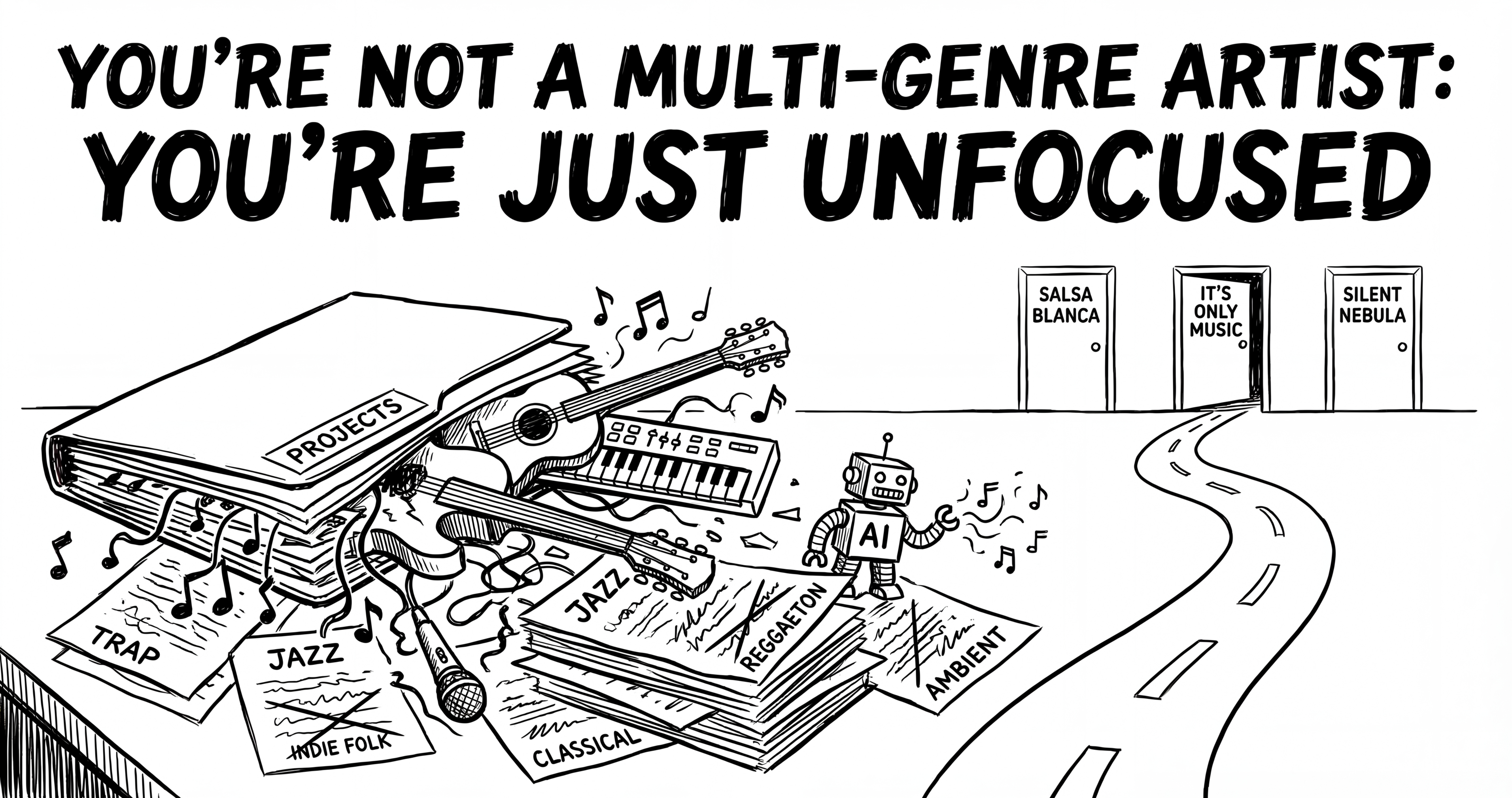
I know that stings. But look at your project folder. How many half-finished tracks are sitting there in genres you don’t actually work in? How many “explorations” into styles you’ll never release?
And if you’re a composer or songwriter chasing sync briefs, it’s even worse.
The Sync Brief Scramble
Here’s what happens every time a brief drops.
Rock writers suddenly become jazz trio experts. Classical composers are now trip-hop masters. The guy who’s been doing indie folk for a decade decides he can knock out a trap beat because the brief says “urban.”
I’m not exaggerating. I’ve watched this happen over and over. A brief comes out asking for authentic Cuban son, and suddenly I’m competing against people who’ve never heard Trío Matamoros but spent three hours watching YouTube tutorials on clave.
And you know what the worst part is? A lot of these people think sync is crap music anyway. They think they can fake it. “It’s just background music. How hard can it be?”
Harder than you think. Because the people reviewing those briefs can tell the difference between someone who knows the style and someone who’s winging it.
Why This Is Bad Business
Diluting your brand isn’t just an abstract marketing problem. It’s a practical one.
When you try to write in ten different genres, you’re not getting really good at any of them. You’re spreading yourself thin. And in a world where clients have access to actual specialists, “pretty good at everything” doesn’t get you work. It gets you passed over.
I learned this the expensive way.
Early in my sync career, I chased briefs. A reggaeton brief came through, and I wrote something. It was okay. Technically competent. Hit the marks.
I mean, it’s Latin, isn’t it? Same thing, right?
Wrong.
It didn’t get picked up.
“Okay” doesn’t cut it anymore. Maybe it never did. The brief went to someone who actually writes reggaeton, who knows the genre inside out, who didn’t have to think about where the dembow pattern sits in the mix because they’ve been doing it for years.
I still write reggaeton. But now it’s cowrites with people who live in that world, for projects that align with my Salsa Blanca label. Not chasing briefs. Not trying to be something I’m not.
The AI Problem You’re Not Thinking About
And here’s the part nobody wants to hear: if you’re already diluting yourself by trying to write in ten genres, AI is going to eat your lunch.
You know what AI is really good at? Mediocre genre exercises. Competent but soulless facsimiles of styles it’s been trained on. The kind of “okay” track that checks all the boxes but doesn’t have anything real underneath it.
If you’re competing on “I can write a passable jazz track even though I’m really a rock guy,” you’re not competing against other humans anymore. You’re competing against software that can generate 50 variations of “passable” in the time it takes you to open your DAW.
The only way to stay ahead is to be undeniably good at what you do. And you can’t be undeniably good at everything.
What I Did About It
I‘ve got projects sitting on my hard drive that will never get finished. Hip-hop sketches. Trap ideas. Styles I don’t listen to, don’t love, don’t have any business trying to write.
They’re wasting space. Both on my drive and in my head. Every time I see them, I’m reminded that I wasted time chasing work that didn’t fit.
I wrote about this before (Nobodys Waiting for Your Perfect Song), but this is the flip side of that problem. It’s not just about finishing things. It’s about starting the right things in the first place.
So I stopped. I niched down. Hard.
I created three labels to keep things straight:
Salsa Blanca: My Cuban and Latin music. The stuff I went to Cuba to study. The music I actually know.
It’s Only Music Records: English songs and jazz. The stuff that came out of my time at Dick Grove School of Music and even before. I’ll call it .
Silent Nebula Records: Ambient and new age. A lane I carved out that doesn’t require me to pretend I’m something I’m not.
Three labels. Three focuses. Everything else got deleted.
This isn’t advice. It’s just what worked for me. But the principle is solid: niche down. Pick a lane, get really good at it, and stop pretending you can write everything.
The Real Cost of “Flexibility”
The industry rewards specialists, not generalists.
When a brief asks for authentic flamenco, they don’t want the guy who “can do anything.” They want the person who’s spent twenty years studying Paco de Lucía.
When a label is building a catalog, they don’t want a mish-mash of genres with no cohesive identity. They want a point of view. A sound. Something they can market.
And when you’re trying to build a career, you can’t afford to be mediocre at ten things. You need to be undeniable at one or two.
“Flexibility” in sync usually just means you’re mediocre at everything. And mediocre doesn’t survive. Not against people who are actually good. And definitely not against AI that can churn out mediocre faster than you can.
Pick a Lane
You can learn other styles. You should learn other styles. Expanding your musical vocabulary makes you better at what you actually do.
But stop trying to compete in genres you don’t live in.
Stop chasing briefs that don’t align with who you are as an artist.
Stop cluttering your hard drive with half-finished ideas in styles you’ll never master.
Pick a lane. Get really f’ing good at it. And let the people who actually know those other genres have them.
You’re not a multi-genre artist. And that’s okay. You don’t need to be.