You can read the full guide below or download the PDF for offline use.
Nobody’s Waiting for Your Perfect Song
Use this infographic as your quick reference while you work:
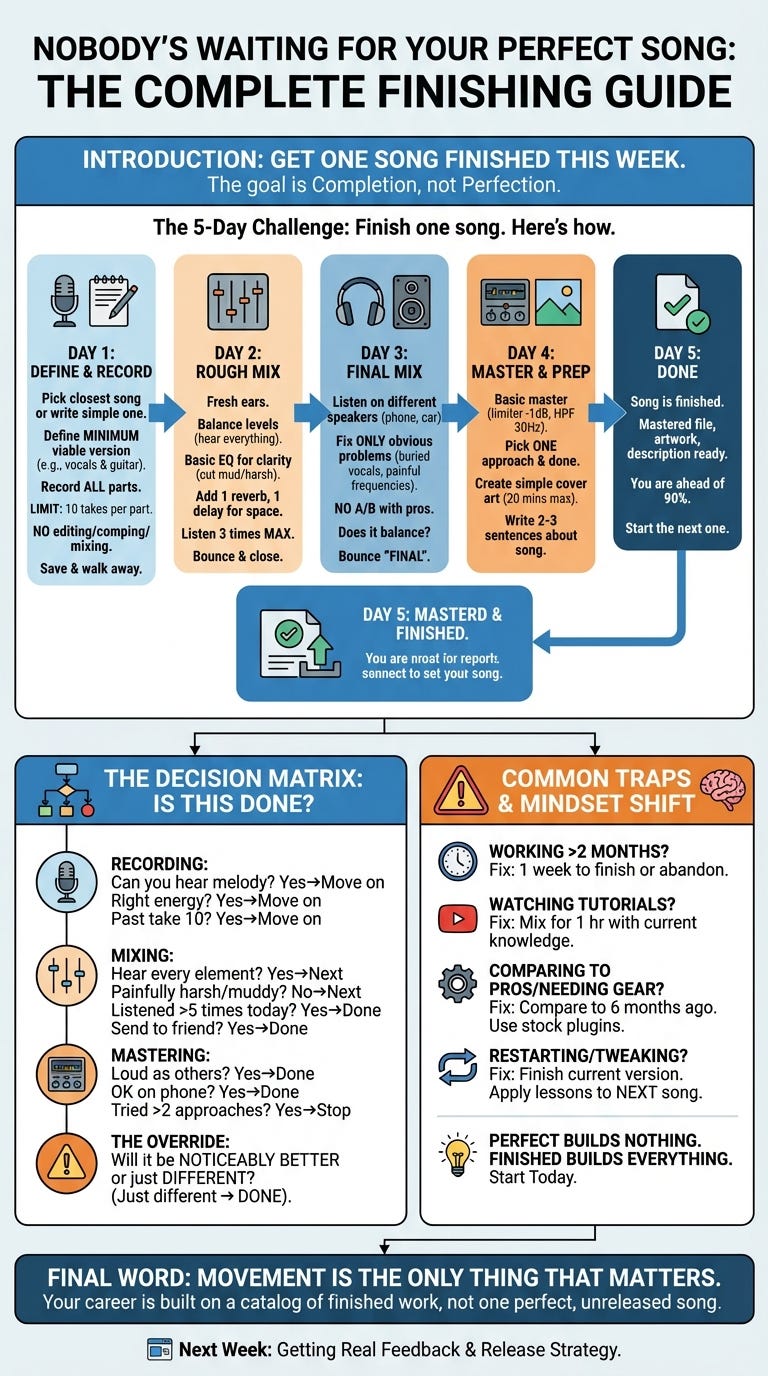
Now let's get into the details...
Introduction: Get One Song Finished This Week
You’re reading this because you’ve got unfinished music on your hard drive. Songs that are “almost there,” mixes that need “just one more pass,” takes that aren’t quite right yet.
This guide isn’t about making better music. You probably already know how to do that. This is about actually finishing what you start.
Everything here is practical. A 5-day framework to finish one song this week. Limits that force decisions. Checklists that tell you when to stop. No theory, just tools.
Next week I’ll write about how to get real feedback on what you’ve finished. The week after that, we’ll cover release strategy and building momentum.
But first: let’s get one song done.
The 5-Day Finishing Challenge
Finish one song in five days. Not perfect, just done. Here’s exactly how:
Day 1: Define and Record
Pick the song closest to done. If nothing’s close, write something simple today. Don’t overthink this.
Define minimum viable version: what does this song actually need to work? Vocals and guitar? Vocals, bass, drums? That’s probably it. Write it down. That’s your limit.
Record all parts. Set a 10-take limit per part. After 10, move on regardless. If you haven’t nailed it by take 10, the problem isn’t your performance. It’s the arrangement, the tempo, or something you’ll fix on the next song.
Do not edit. Do not comp. Do not mix. Just get everything recorded.
Save the session. Close it. Walk away.
Day 2: Rough Mix
Open yesterday’s session with fresh ears.
Get levels balanced so you can hear everything. Vocals clear, kick and snare audible, bass present, everything else supporting.
Add basic EQ only if something’s obviously muddy or harsh. Not for “character,” for clarity.
Add reverb and delay if the song needs space. One reverb, one delay, done.
Listen through once. Make adjustments. Listen through twice more maximum. If you listen more than three times total, you’re overthinking.
Bounce a rough mix. Save the session. Close it.
Day 3: Final Mix
Open yesterday’s rough mix and the session.
Listen to the rough mix on different speakers. Phone, car, headphones, whatever you’ve got.
Fix only what’s obviously wrong. Vocals buried, kick inaudible, something painfully harsh. That’s it.
Do not A/B against reference tracks. Do not chase “professional sound.” Do not tweak for vibe.
Make your fixes. Listen through once. Does it sound balanced? Can you hear everything that matters? Yes? Bounce it.
Save the session as “FINAL” so you don’t open it again. Close it.
Day 4: Master and Prep
Run your final mix through basic mastering. Use Landr, eMastered, or a simple mastering chain: limiter to -1dB, slight compression if it needs glue, high-pass filter at 30Hz. That’s sufficient.
Don’t compare three different masters. Pick one approach, run it, done.
Create cover art. Phone photo, simple graphic, text on a color, anything that isn’t a blank square. Spend 20 minutes maximum.
Write 2-3 sentences about the song. What it’s about, why you made it, whatever. You’ll need this next week when I cover getting feedback.
Day 5: Done
Your song is finished. Mastered file, artwork, description, ready to go.
Next week’s article will tell you exactly who to send it to and how to get useful feedback before you release it publicly.
For now: you finished something. That puts you ahead of 90% of musicians stuck in perfectionism hell.
Start the next song.
The Decision Matrix: Is This Done?
Use this flowchart anytime you’re stuck deciding if something’s ready.
For Recording:
Can you hear the melody/lyrics clearly?
Yes → Move on
No → One more take, then move on anyway
Does it have the right energy/emotion?
Yes → Move on
No → Check tempo or arrangement, not your performance
Are you past take 10?
Yes → Move on regardless, more takes won’t fix this
No → Keep going but watch the limit
For Mixing:
Can you hear every important element clearly?
Yes → Next question
No → Fix levels only, nothing else
Is anything painfully harsh or muddy?
Yes → EQ that one thing
No → Next question
Have you listened to this mix more than 5 times today?
Yes → Save and close, you’re done
No → Next question
Would you send this to a friend right now?
Yes → You’re done, bounce it
No → Fix the one thing stopping you, then you’re done
For Mastering:
Is it as loud as other music you listen to?
Yes → Done
No → Add limiting, then done
Does it sound decent on phone speakers?
Yes → Done
No → Check your low end, then done
Have you tried more than two mastering approaches?
Yes → Pick one and stop
No → Stop anyway after this one
The Override:
Anytime you catch yourself saying “just one more thing,” ask: will this make it noticeably better or just different?
If the answer isn’t obviously “better,” you’re done.
Recording Limits That Actually Work
Set these rules before you start any recording session. They force decisions instead of endless options.
Take Limits:
Vocals: 10 takes maximum per section
Guitars/Bass: 5 takes per part
Solos/Lead parts: 3 takes (first take energy usually wins)
Drums: 5 takes per section if programming, 3 if playing live
If you haven’t nailed it within these limits, the problem is not your playing. It’s tempo, arrangement, or you’re tired.
Time Limits:
Recording session: 3 hours maximum
After 3 hours your ears are shot and your judgment is garbage
Schedule another session tomorrow if needed, don’t push to 6 hours
The First Take Rule:
Always keep take 1, even if you do more takes
70% of the time, take 1 or 2 has better energy than take 47
Before you pick your “best” technical take, compare it to take 1
If take 1 has more life, use take 1
The Comp Exception:
If you must comp vocals, comp from the first 5 takes only
Don’t create a Frankenstein from 20 different takes
Limit yourself: verse from take 2, chorus from take 1, bridge from take 3, done
More than 3 sections comped means you should’ve just done another full take
When to Stop Recording:
Stop immediately if any of these apply:
You have one complete take that works (even if imperfect)
You’ve hit your take limit
You’re thinking “maybe I should change the arrangement” (do that next song)
It’s been more than 2 hours on one part
You’re getting worse, not better
You’re thinking about gear instead of performance
The Mixing Checklist: How to Know When to Stop
Mixing never feels done because there’s infinite options. This checklist creates a finish line.
Phase 1: Balance (30 minutes maximum)
□ Can you hear the vocals clearly? □ Can you hear the kick and snare? □ Can you hear the bass? □ Is anything buried that should be audible? □ Does anything fight for the same space?
If yes to first four and no to the last: move to Phase 2
Phase 2: Cleanup (30 minutes maximum)
□ Is anything painfully harsh? (Cut those frequencies) □ Is anything super muddy? (Cut low-mids around 200-400Hz) □ Does anything need space? (Add one reverb, one delay maximum) □ Are there clicking, popping, or obvious technical problems?
If fixed: move to Phase 3
Phase 3: Final Check (One listen through, no touching the mouse)
□ Does this sound balanced? □ Can you hear everything that matters? □ Would you send this to someone right now?
If yes: bounce it. You’re done.
Signs You’re Done (Stop Immediately):
You’re tweaking the same thing for the third time
You can’t remember what you just changed
You’re comparing your mix to mastered commercial releases
You’re adjusting things by 0.5dB
You’ve been mixing for more than 2 hours in one session
You’re thinking “maybe I should rerecord this part”
You’re solo’ing tracks and making decisions (always listen in context)
You’re watching YouTube tutorials instead of mixing
The 24-Hour Rule:
Mix until the checklist is complete. Bounce it. Close the session.
Listen tomorrow on different speakers (phone, car, earbuds).
Fix only what’s obviously broken. Vocal buried, kick inaudible, something painful.
Bounce again. Close the session. You’re done.
Do not open it a third time.
Mixing Time Limit:
Total time per song: 3-4 hours maximum across 2 days.
After that you’re making it different, not better. And you’ve lost perspective.
Common Traps: If You’re Doing This, Stop
Trap: You’ve been working on the same song for more than 2 months
Fix: Give yourself 1 week to finish or abandon it. Either finish it or admit it’s not worth finishing. Both are valuable.
Trap: You’re watching mixing tutorials instead of mixing
Fix: Close YouTube. Mix for 1 hour using only what you already know. You’ll learn more.
Trap: You’re comparing your rough mix to mastered commercial releases
Fix: Stop. Compare to where you were 6 months ago. Or compare to nothing. Just make it sound balanced.
Trap: You’re on take 47 of the same part
Fix: Stop recording. Listen to takes 1-5. Pick the one with the most life. After take 10 you’re removing energy, not adding it.
Trap: You’re tweaking the same EQ for the third time
Fix: Close the session. Walk away. You’re past improvement and into destruction of perspective.
Trap: You’re researching what plugin to buy
Fix: Make 3 complete songs using only stock plugins. Then reassess. (You probably don’t need more tools.)
Trap: You’re restarting the same song from scratch
Fix: Finish the current version even if it’s flawed. Apply lessons to the next song, not this one. Restarting is sophisticated procrastination.
Trap: You’re waiting for inspiration before you work
Fix: Set a timer for 30 minutes. Work on something regardless of how you feel. Inspiration shows up during work, not before it.
Trap: You’re asking 10 different people for mixing advice
Fix: Pick one trusted source or trust your ears. Too many opinions creates paralysis.
Trap: You’re recording everything 5 different ways “to have options”
Fix: Commit to one approach. Record it. Move on. Options later means paralysis later.
Trap: You’re waiting for the “right time” to finish
Fix: There is no right time. The right time is now. Finish this week.
The Pattern:
If you’ve been stuck in the same place for more than a week, you’re in a trap.
The fix is always the same: make a decision and move forward.
Any decision beats no decision.
Finished and flawed beats perfect and nonexistent.
Your 7-Day Progress Log
Track this for 7 days while you finish your first song. Copy this into a document or notebook.
Daily Check-In (2 minutes before bed):
Day: ___________
Today I worked on: ___________
Time spent: _____ hours
Did I finish anything today? □ Yes - what: ___________ □ No
If no, why not? □ Overthinking what to do □ Redoing something I already did □ Researching instead of doing
□ Got stuck on: ___________ □ Legitimate reason: ___________
Tomorrow I will: ___________
End of Week Review:
This week I:
Finished: ___________
Got stuck on: ___________
Learned: ___________
Be honest: Did perfectionism show up? Where?
Next week I will finish: ___________
The Goal:
By day 7, you should have one finished song.
If you don’t, look at your log. Where did you get stuck? Which trap showed up most?
That’s what you work on next week while finishing song two.
What Happens Next
You’ve got this guide. Now use it.
Do the 5-Day Challenge. Follow the limits. Use the decision matrix when you get stuck. Watch for the traps.
One week from now you should have a finished song.
Next week I’ll write about what to do with it:
Who to send it to for real feedback (not your supportive friends)
How to ask questions that get useful answers
Where to test it before wide release
What feedback actually matters
The week after that: release strategy, building momentum, catalog building for independent musicians.
But none of that matters if you don’t have finished music.
So finish one song this week.
Then come back next week and we’ll talk about what to do with it.
Final Word: Just Start
Everything in this guide works if you use it.
The 5-Day Challenge will get you a finished song. The limits will force you past perfectionism. The decision matrix will unstick you. The traps checklist will show you your patterns.
Here’s what you do today:
Pick the song closest to done (or start a simple new one)
Set your limits before you start
Follow Day 1 of the challenge
Track it in your progress log
One week from now you’ll have a finished song. That’s more than most musicians will finish this month.
Then you do it again. And again.
That’s how catalogs get built. That’s how skills develop. That’s how careers happen.
Perfect builds nothing.
Finished builds everything.
Start today.